
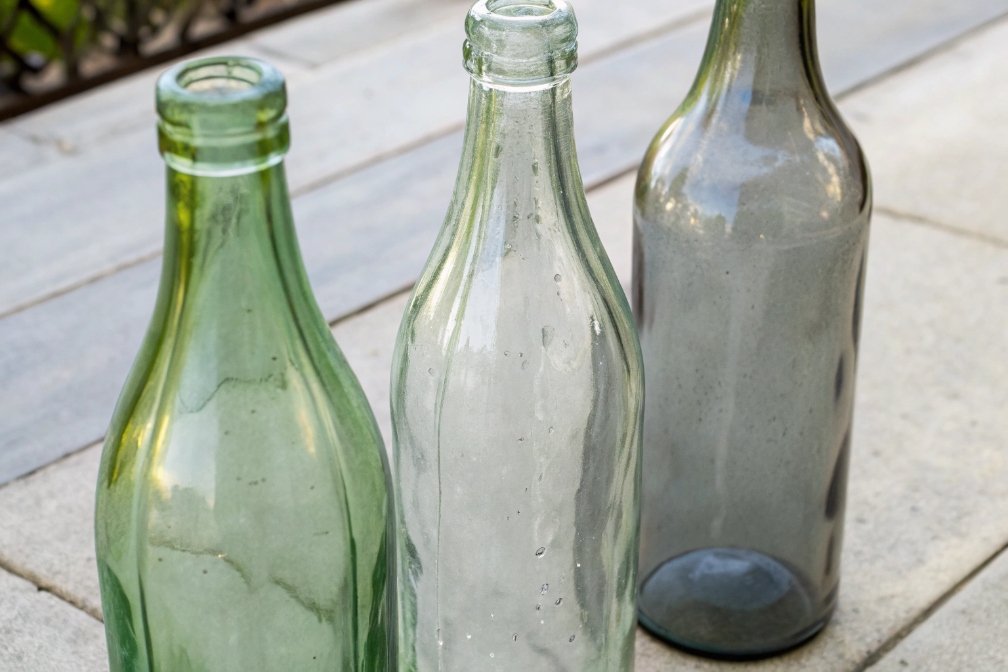
When you pick up an unknown glass bottle, you do not always know if it can handle heat, pressure, or if it is even food safe.
You can identify a bottle’s material by combining visual cues, weight and density, markings, and—when needed—quick lab tools like XRF or FTIR to confirm the exact glass grade.
In practice, we start with what costs nothing: look, touch, sound, and markings. Then we move to simple physical tests, and only when necessary to instrument analysis. This step-by-step approach makes it easier to classify bottles as soda-lime, borosilicate, or leaded glass without destroying them.
What visual cues separate soda-lime, borosilicate, and leaded glass?
Not all clear glass is the same. Some pieces survive boiling water, some shatter with a small heat shock, and some should never touch food.
Soda-lime, borosilicate, and leaded glass differ in color tone, brilliance, weight feel, and ringing sound, so trained eyes and ears can often separate them before any lab test.
Soda-lime glass is the standard for most beverage and food bottles. At thick sections, it often shows a slight green or blue-green tint, especially along the base or at the punt. It feels solid and quite heavy for its volume, with a density around 2.5 g/cm³. When you tap it gently with a metal spoon, the sound is clear but short, without a long musical ring. A quick technical refresher on soda-lime glass composition and properties 1{#ref-1} helps explain why it behaves this way.
Borosilicate glass usually looks more “neutral” in color. At thick edges, it tends to be less green than soda-lime and can look slightly grayish or very clear. For the same size bottle, it often feels a bit lighter because the density is lower, usually around 2.2–2.3 g/cm³. The tap sound is clean but not as bright as lead crystal, and the visual sparkle is lower because light dispersion is lower. If you need a spec-style reference point, SCHOTT’s borosilicate “33” optical/thermal property sheet 2{#ref-2} is a good benchmark.
Leaded glass (often sold as “crystal”) is another story. It feels noticeably heavier in the hand for the same size, often 2.9 g/cm³ or higher. It has very high brilliance and dispersion, so you see strong rainbow edges and sparkle where light passes through cuts or thick corners. When you tap it, the sound is long and bell-like; it “sings” instead of just clicking. Britannica’s note on leaded “crystal” and why it has higher refractive index and ring 3{#ref-3} matches the real-world cues people notice.
Surface details and typical use also help:
- Most mass-market drink bottles are soda-lime.
- Labware, kettle carafes, and premium coffee servers are very often borosilicate.
- Cut decanters, luxury drinkware, and some decorative pieces may be leaded glass or lead-reduced crystal.
By combining color at the heel, weight feel, and sound, you can narrow down the category before doing any measurements.
| Property | Soda-lime bottle glass | Borosilicate bottle / lab glass | Leaded crystal / lead glass |
|---|---|---|---|
| Typical use | Food and beverage packs | Lab bottles, heatware, servers | Decanters, stemware, décor |
| Tint at thick edge | Green / blue-green | More neutral, slightly gray | Very clear, bright |
| Density (approx.) | ~2.5 g/cm³ | ~2.2–2.3 g/cm³ | ≥2.9 g/cm³ |
| Sparkle and rainbows | Moderate | Lower | Very high |
| Tap sound | Short, clear “clink” | Clean but not very musical | Long, bell-like “ring” |
Can density or refractive index tests confirm composition?
Visual checks are fast, but sometimes a bottle sits on the boundary, or the color and finishing make judgment hard.
Yes. Simple density measurements and refractive index tests can strongly indicate whether a bottle is soda-lime, borosilicate, or leaded glass, especially when combined with what you already see.

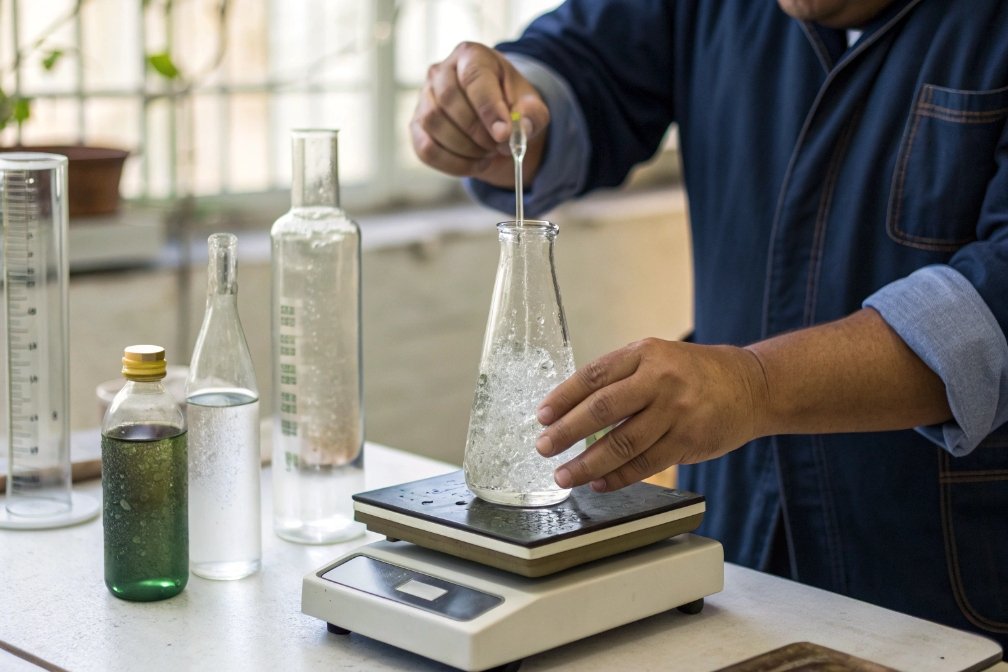
A basic density test is surprisingly powerful and can often be done with simple tools. The principle is straightforward: density = mass / volume.
For a bottle body sample, or for a broken-off fragment from a test piece, many labs rely on a water displacement method based on Archimedes’ principle 4{#ref-4}:
- Weigh the dry piece on a precise scale.
- Submerge it in water and measure the displaced volume (graduated cylinder or overflow method).
- Divide mass by volume to get density.
Values near 2.5 g/cm³ point to soda-lime glass. Values around 2.2–2.3 g/cm³ suggest borosilicate, and values close to or above 2.9 g/cm³ indicate leaded glass or high-lead crystal.
Refractive index is another fingerprint. In forensics, an immersion method for refractive index measurement 5{#ref-5} is commonly used on small glass fragments, and the same logic can support “what glass family is this?” screening when you have a questionable bottle fragment.
In many factories and quality labs, we combine:
- Density for a quick physical check.
- Instrumental analysis (such as XRF) for exact composition.
- Visual appearance and customer documentation.
Do embossings or batch codes indicate material type?
Sometimes the fastest way to know the glass is simply to read what the manufacturer already printed on it.
Embossed markings, brand names, recycling codes, and standard neck designations often give strong clues about glass type, especially for labware, pharma, and packaging bottles.
On lab and heat-resistant products, many makers state the glass family very clearly. Typical examples include:
- “BORO 3.3”, “Borosilicate 3.3” on lab bottles and beakers.
- “PYREX” (lab grade), “DURAN”, “Simax”, and similar marks for borosilicate.
- “Heat resistant glass” on some household and coffee carafe products.
- “TEMPERED” on some soda-lime items that have been thermally toughened.
For leaded glass, decorative pieces and drinkware may carry labels such as “Lead crystal” or “24% PbO,” but small bottles and older items may have no clear marking, so you cannot rely on labeling alone.
Batch and mold codes on the base identify where and when the bottle was made, and on which cavity. They usually do not say “this is borosilicate,” but they help trace back to plant documentation where composition is known.
Which rapid lab methods (XRF/FTIR) verify the glass grade?
Visual checks, labels, and density are helpful, but serious decisions sometimes need hard numbers. For that, we use quick, non-destructive tools.
Handheld XRF, LIBS, and other spectrometric tools can rapidly measure glass composition, while techniques like FTIR or lab ICP confirm the grade when full certification is required.
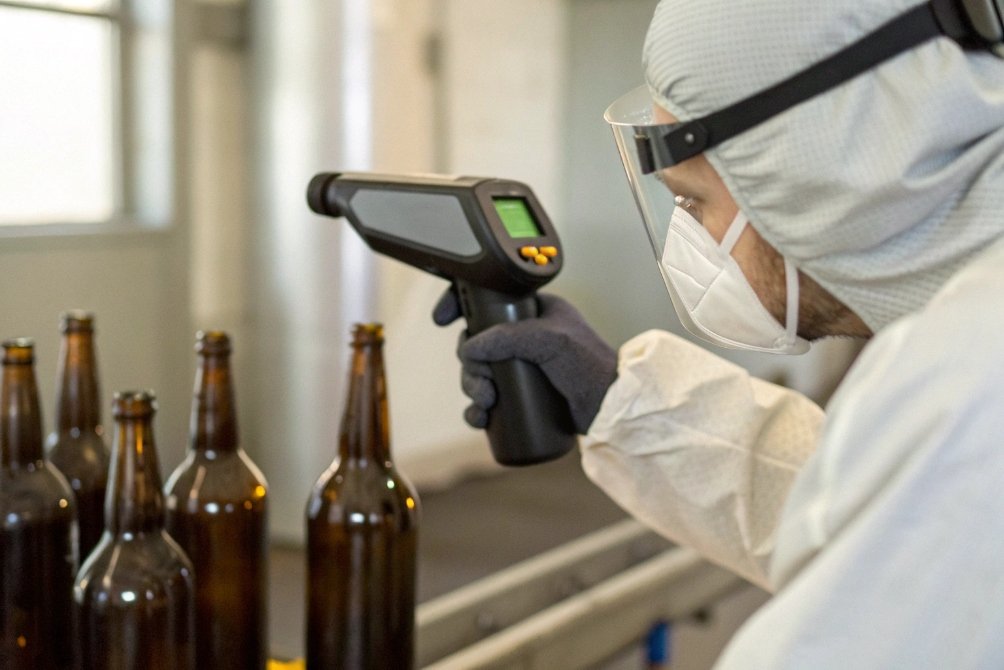
XRF (X-ray fluorescence) is one of the most practical tools for fast glass ID. A handheld unit aimed at the bottle surface can detect key elements such as boron (for borosilicate) and lead (for leaded glass). For a plain-language explanation of what handheld XRF does and what it detects 6{#ref-6}, it is a good starting point before you write an incoming-inspection SOP.
LIBS (laser-induced breakdown spectroscopy) is another rapid method used for glass chemistry work. If you need a practical, glass-specific overview, this note on LIBS as direct sampling for glass analysis 7{#ref-7} shows why it is attractive for multi-element ID.
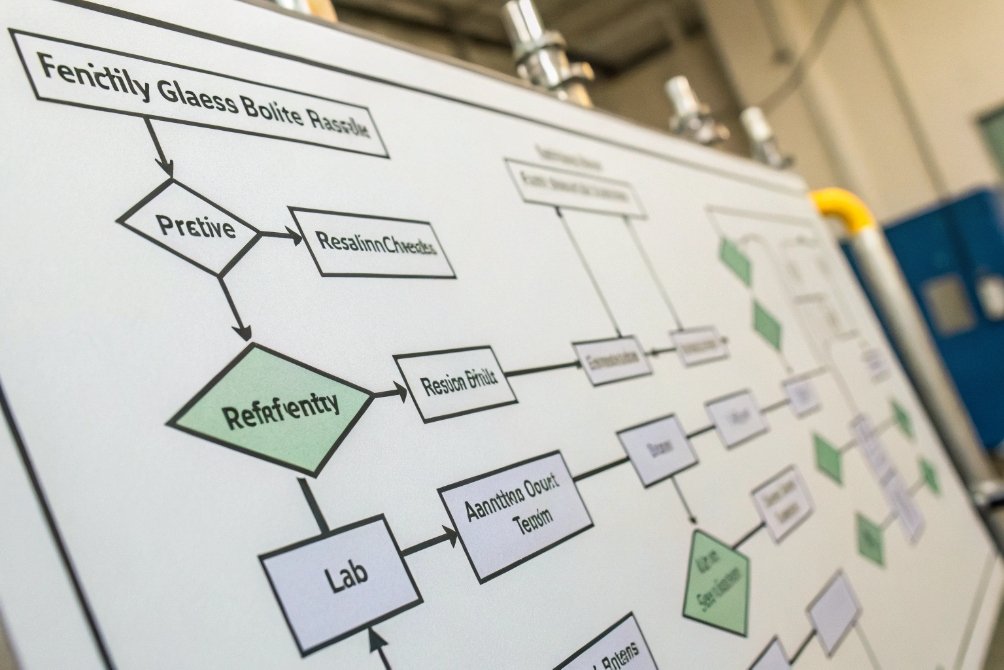
In day-to-day practice, a simple hierarchy works well:
- Visual and context clues: color, usage, marked brand or standard.
- Physical clues: weight feel, ring sound, optional density test.
- Markings and documents: embossing, recycling codes, technical data sheets.
- XRF or similar: fast, objective confirmation when risk or value is high.
- Full lab analysis: only when regulations or investigations demand it.
Conclusion
To identify a glass bottle’s material, start with eyes, hands, and markings, then use density and quick spectrometric tools like XRF when you need proof beyond guesswork.
Footnotes
-
Defines soda-lime glass composition, explaining common tint, density, and everyday packaging performance. ↩ ↩
-
Provides a borosilicate “33” benchmark for thermal/optical properties used in heat-resistant glass identification. ↩ ↩
-
Explains why leaded crystal has higher brilliance and “ring” due to refractive index and elasticity changes. ↩ ↩
-
Supports the water-displacement approach used to measure density quickly and distinguish major glass families. ↩ ↩
-
Practical guideline for refractive index immersion methods commonly used to characterize unknown glass fragments. ↩ ↩
-
Clear overview of handheld/portable XRF for non-destructive elemental identification (useful for lead/boron screening). ↩ ↩
-
Explains LIBS as a rapid technique for glass elemental analysis when you need fast, objective grade confirmation. ↩ ↩






