
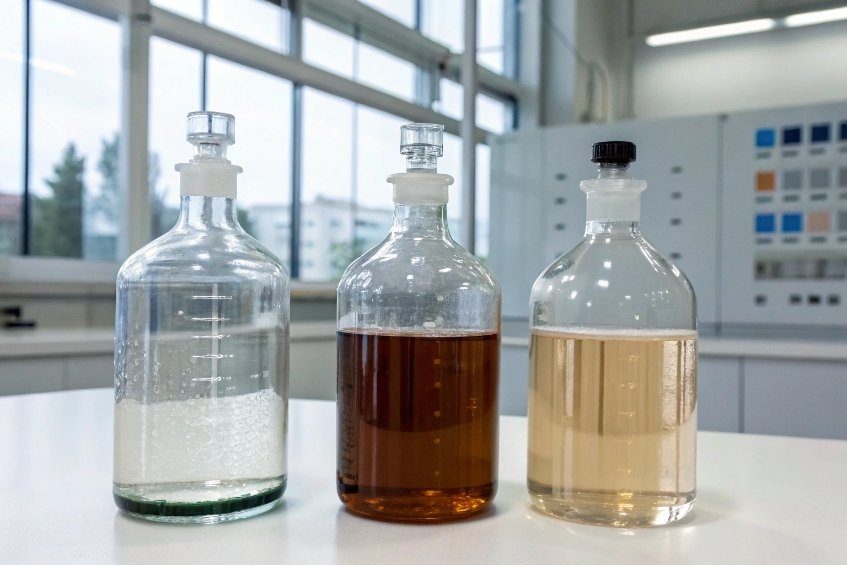
Sudden temperature swings break glass not only because of heat, but because different glasses expand at different rates. That invisible coefficient of thermal expansion (CTE) 1 runs the whole show.
CTE values differ because each glass family has a different chemistry and network structure. Soda-lime expands about three times more than high-borosilicate, with middle-borosilicate in between, so thermal shock limits and process windows change by glass type.
In real projects, CTE is not a lab curiosity. It decides which bottle survives thermal shock 2, which cracks in pasteurization, and how hard a closure can be torqued after cooling. So I always think in terms of “glass family + process temperature + closure system” as one linked design problem.
How do soda-lime, middle-borosilicate, and high-borosilicate compare in expansion?
When people say “all glass is the same,” they usually mean soda-lime bottles. Once borosilicate joins the conversation, the expansion story changes fast.
Soda-lime container glass has a CTE around 9–9.5 ×10⁻⁶ K⁻¹, while high-borosilicate “3.3” is near 3.3 ×10⁻⁶ K⁻¹, with middle-borosilicate in the 4–5 ×10⁻⁶ K⁻¹ range. So expansion can differ by almost 3×.
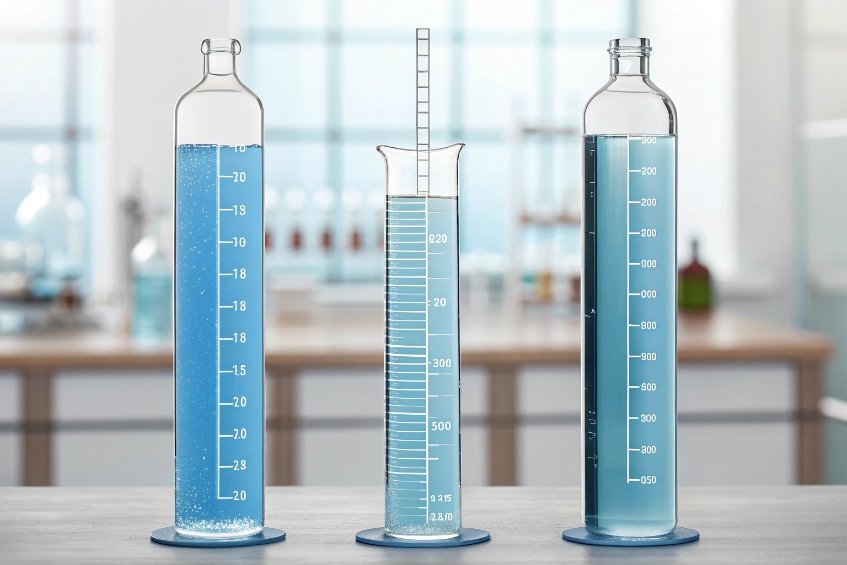
How the main glass families stack up
For container and technical packaging work, three silicate families show up most:
- Soda-lime container glass 3 (standard bottles and jars)
- Middle-borosilicate “TEC 51” glass tubing 4 (many pharma and technical glasses)
- High-borosilicate “3.3” glass tubing 5 (labware, high-end pharma, some food / drink specials)
At a high level, the CTE ladder looks like this (mean linear CTE, typical 20–300 °C or similar range):
| Glass family | Typical CTE (×10⁻⁶ K⁻¹) | Relative to soda-lime | Typical use cases |
|---|---|---|---|
| High-borosilicate 3.3 | ~3.3 | ~1/3 | Labware, high-end pharma, cookware |
| Middle-borosilicate | ~4.0–5.0 | ~1/2 | Pharma vials, ampoules, tech packaging |
| Soda-lime container glass | ~9.0–9.5 | baseline | Food, beverage, cosmetics, daily bottles |
You already pointed out the key pattern: more silica and boron push CTE down, while more alkali, alkaline-earth, or lead push it up. That is why fused silica sits near 0.5 ×10⁻⁶ K⁻¹, borosilicate around 3–5, and “richer” commercial glasses like soda-lime and many phosphate glasses move toward 9–20 ×10⁻⁶ K⁻¹ and above.
Two practical notes that often get missed in packaging talks:
- CTE depends on the temperature interval. The same glass will give slightly different CTE from 20–100 °C vs 20–300 °C. Data sheets always define this range, and design should match the real operating window.
- Thermal history matters. How the glass was annealed and cooled shifts relaxation state a little, which nudges CTE and stress behavior. For everyday bottles the change is small, but in precision applications it becomes important.
If you need to compare suppliers, insist the test method is declared (for example ASTM E228 6 or ISO 7991 7) so you are not comparing “similar-looking” numbers made under different rules.
So, from a process engineer’s point of view, soda-lime is the “fast mover” glass. Middle-borosilicate is a calmer version. High-borosilicate 3.3 is the slow expander that can tolerate steeper temperature gradients before stress crosses the cracking threshold.
What do CTE differences mean for hot-fill, pasteurization, and thermal cycling?
On a hot-fill line or pasteurizer, glass does not only see heat. It sees temperature difference between the hot product and the outer surface, and between one part of the bottle and another.
Lower-CTE glass can survive higher temperature differences and faster heating or cooling rates. Soda-lime needs tighter control of ΔT and line conditions, while borosilicate allows more aggressive hot-fill, pasteurization, and thermal cycling with fewer breakages.
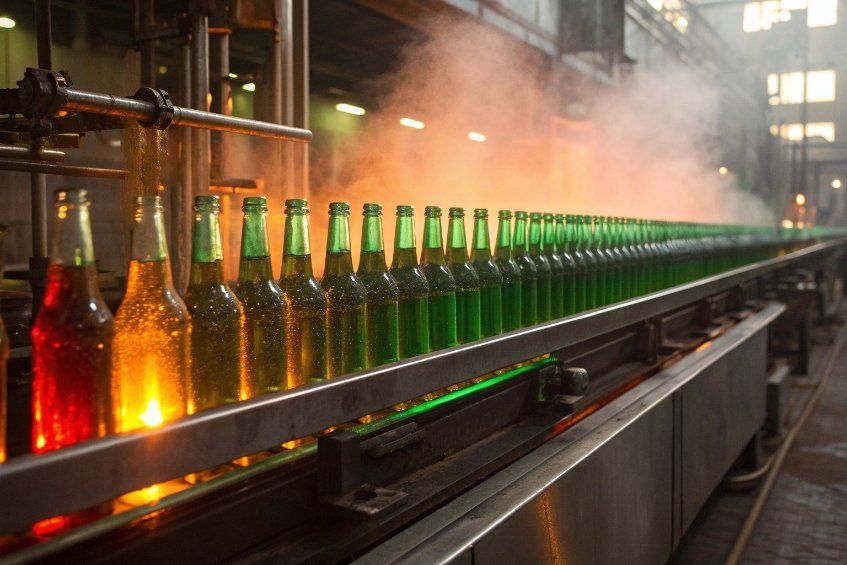
Translating CTE into real process limits
CTE tells us how much the glass wants to expand for each degree of temperature rise. Thermal stress comes from parts of the bottle that want to expand by different amounts at the same time. For a given temperature gradient:
- Higher CTE → higher internal stress
- Lower CTE → lower internal stress
From that, a few direct consequences follow.
1. Hot-fill processes
Typical hot-fill juices, teas, or sauces might fill at 80–95 °C into bottles that sit at 20–30 °C.
-
Soda-lime
- Needs tighter control of pre-heat, product temperature, and bottle design.
- Ribbing, controlled thickness in shoulder and heel, and pre-heated bottles help manage thermal shock.
- A sudden 60–70 °C jump on a cold, thick-shoulder bottle is where cracks start.
-
Middle-borosilicate
- Better thermal shock margin, so the same design survives slightly higher ΔT or faster line speeds.
- Often used in more demanding pharma fills, where sterilization and hot-fill combine.
-
High-borosilicate 3.3
- Thermal shock resistance is strong enough that hot-fill is rarely the limiting factor.
- Mechanical handling (impact) or cost tends to limit more than thermal stress.
2. Pasteurization and retort
Pasteurization curves involve heating, holding, and cooling, often with water sprays or baths. Thermal cycling happens over many minutes.
-
Soda-lime bottles survive standard pasteurization well if design and annealing are correct. Problems show up when:
- The bottle has strong thickness gradients.
- Cold spots are hit with hot water spray.
- Cooling is too fast at the end of the cycle.
-
Middle- and high-borosilicate bottles tolerate:
- Higher pasteurization temperatures at the same safety level.
- More cycles in re-use systems, because each cycle creates less cumulative damage.
In practice, many beverage lines stick with soda-lime for cost and availability, then control thermal curves and bottle design to stay within safe stress limits.
3. Thermal cycling during use
Think about a consumer pouring hot liquid into a bottle taken from a cold room, or putting a container from a fridge into warm water.
- Low-CTE borosilicate shrugs off these everyday abuses.
- Soda-lime is much closer to its safety edge, so labels and guidance (“do not pour boiling water”) become part of the design.
So the big message is simple: CTE sets the size of the safe thermal window. Lower CTE widens that window; higher CTE forces the process and design to be more careful.
Should closure liners and cap torques change with lower-CTE glass?
Closure design often focuses on polymers and metal caps, but the glass neck is a very stiff part of that system. Different CTE means the neck moves differently during heat and cool steps.
As CTE drops, the glass neck expands and shrinks less than plastic closures do. Torque, seal load, and liner compression all change over the thermal cycle, so liner hardness and target torque often need tuning for each glass family and process.
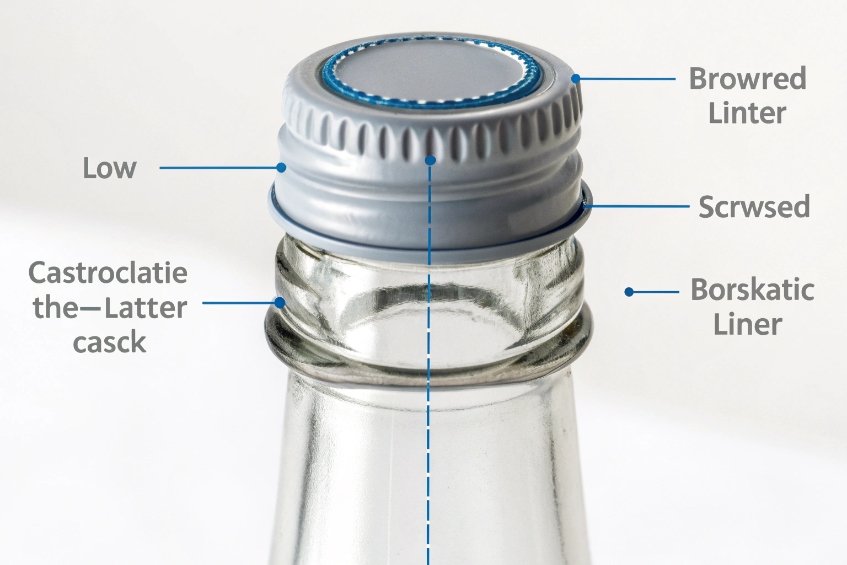
Matching glass, liner, and torque as one system
Polymers used in caps (PP, HDPE, TPE liners) usually have CTE values an order of magnitude higher than glass. So, during hot-fill and cooling:
- The closure grows and shrinks a lot.
- The glass neck moves very little, especially for low-CTE borosilicate.
This mismatch creates complex stress in threads and liners.
1. Compared to soda-lime, what changes with borosilicate?
Because borosilicate has lower CTE, its neck diameter over the cycle is slightly more “stable” than soda-lime. The closure still moves a lot. So two things happen:
-
Torque development over cooling
- With soda-lime, both neck and cap shrink in their own ways. The final torque is a result of how both move.
- With borosilicate, the neck is more dimensionally stable. The cap does most of the shrinking, so the torque and top load may end up higher or lower depending on design.
-
Liner compression and relaxation
- Softer liners may see higher peak compression under aggressive hot-fill and cooling.
- Stiffer liners may not flow enough to accommodate mismatch, which can create leak paths or stress in the sealing land.
In real lines, this sometimes shows up as:
- OK seal at ambient torque test.
- Surprise leakage after hot-fill and cooling.
- Or, caps that feel “too tight” or “too loose” after abuse tests.
2. What can we adjust?
Typical levers when changing from soda-lime to middle- or high-borosilicate are:
| Parameter | Direction of change with lower-CTE glass | Why it helps |
|---|---|---|
| Liner hardness | Slightly softer | Absorbs differential movement better |
| Liner thickness | Slightly thicker | More cushion and sealing range |
| Application torque | Often reduced a little | Limits over-compression after cooling |
| Thread design details | Local tweaks | Smooth stress peaks, improve release |
| Torque inspection curve | Re-qualified | New “sweet spot” vs leakage and strip |
So yes, closure specs should not blindly copy from soda-lime when the glass family changes. Even if the CTE difference looks small on paper, it interacts with a much higher-CTE closure, and that is where real-world leakage or over-tightening shows up.
Do forming and annealing settings need adjustment by glass family?
On the hot end, CTE links back to glass composition, and composition changes viscosity, working range, and annealing behavior. So a borosilicate bottle will not behave like a soda-lime bottle in the forming and annealing line.
Different glass families require different gob temperatures, forming timings, and annealing curves. Soda-lime runs at lower working temperatures with wider forming windows, while borosilicate usually needs higher temperatures and slower or hotter annealing to relax stress properly.
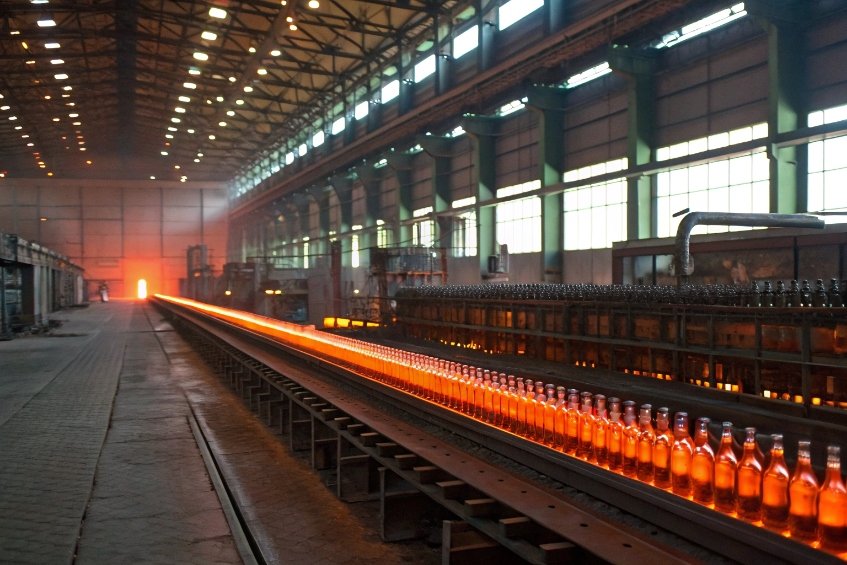
How CTE and forming/annealing link together
CTE is not the direct input in the forming machine, but it reflects the underlying chemistry that also controls viscosity and glass transition temperature.
1. Forming behavior by glass family
-
Soda-lime container glass
- Well-known, forgiving forming behavior.
- Gob temperatures and mold timings have wide industrial experience and many reference recipes.
- Suitable for very high-speed bottle lines with strong cost pressure.
-
Middle-borosilicate
- Higher working temperatures than soda-lime.
- Viscosity curve can be steeper, so forming window is narrower.
- IS machine settings (gob length, reheat, air timing) often need fine tuning and tighter control.
-
High-borosilicate 3.3
- Even higher working temperature.
- Very specific forming window, less forgiving of temperature drift or timing errors.
- Often used on lines that run slower but target high technical quality instead of pure throughput.
In simple words: borosilicate is “harder to push around” when cold, and “more fluid” when hot in a narrower temperature band. Operators see this as a glass that “goes from too stiff to too soft very fast” if temperatures are not well controlled.
2. Annealing and stress relaxation
After forming, every bottle passes through an annealing lehr. Here, CTE is a direct player:
- Higher CTE means that, for a given temperature gradient while cooling, internal stress rises faster.
- Lower CTE calms those stresses, but the glass transition and annealing temperatures may shift.
For each family, typical adjustments are:
| Glass family | Annealing focus | Practical changes often needed |
|---|---|---|
| Soda-lime | Standard profiles, high experience | Baseline lehr curve and belt speed |
| Middle-borosilicate | More careful stress control | Slightly higher lehr temp or longer soak |
| High-borosilicate | Precise stress management, low distortion | Slower cooling zones, tighter monitoring |
Because borosilicate bottles often go into autoclaves, hot-fill, or repeated thermal cycles, residual stress limits are stricter. Polariscopic inspection and stress criteria can be tougher than for a simple beverage bottle.
3. Why we should not mix profiles
A common temptation is to run a borosilicate job on a line tuned for soda-lime and “see what happens.” Usually, what happens is:
- Acceptable basic shape, but higher defect rates.
- Hidden internal stress that only shows later under thermal or mechanical load.
- Inconsistent dimensions due to forming near the edge of the viscosity window.
So yes, forming and annealing settings are not universal. They must be tuned per glass family, and serious jobs often tune even per composition within that family.
Conclusion
CTE differences are small numbers on paper, but they reshape hot-end settings, thermal process limits, and closure behavior for every glass packaging project.
Footnotes
-
Understand what CTE is, how it’s defined, and why it varies with temperature. ↩ ↩
-
See a clear explanation of thermal shock and why low-CTE glass survives bigger temperature jumps. ↩ ↩
-
Review soda–lime glass composition, typical properties, and why it dominates container packaging. ↩ ↩
-
Reference a real TEC 51 (middle-borosilicate) datasheet with thermal expansion and key physical properties. ↩ ↩
-
Reference a real “3.3” class borosilicate datasheet showing low thermal expansion and related properties. ↩ ↩
-
Check the official ASTM method requirements so CTE data from different labs stays comparable. ↩ ↩
-
Confirm the ISO method context for mean linear CTE of glass in the solid state. ↩ ↩






