
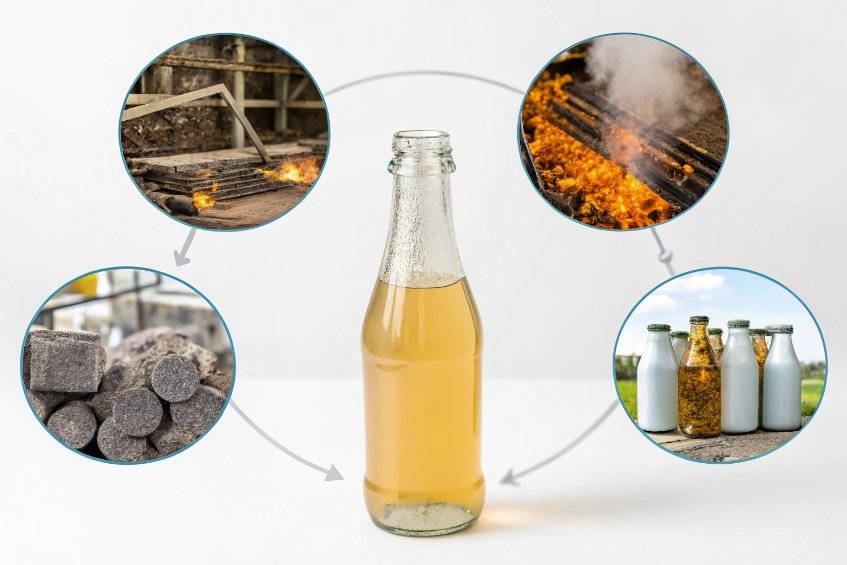
Glass bottles feel “inert” and stable. But color and surface appearance still change under heat, light, chemicals, and poor handling, especially when composition and coating are not well controlled.
Discoloration and surface degradation come from three places: glass chemistry and furnace redox, environmental attack on the surface, and behavior of coatings, inks, and residues. Good storage and handling then decide if these risks stay under control.
Color is not only a design choice. It is the result of furnace conditions, cullet mix, surface reactions, and decoration systems. When any of these drift, the bottle body begins to show haze, iridescence, yellowing, or dirty tones that brands do not want.
Do furnace redox shifts or cullet ratios change body color tone?
Color tone starts in the furnace. If the redox balance moves or the cullet mix changes, the same “recipe” can give a different shade or even streaky color.
Color tone in the bottle body changes when furnace redox, cullet composition, or forehearth conditions push colorants into different oxidation states or local concentrations. This shows up as shade drift, green or amber casts, or localized dark cords and specks.
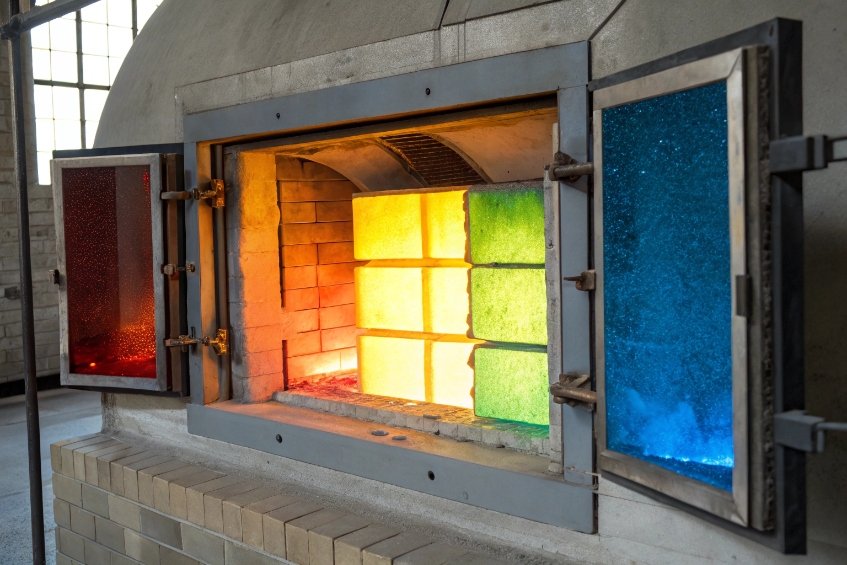
How furnace chemistry drives color variation
Color in container glass mainly comes from small amounts of iron, manganese, selenium, cobalt, and other oxides. Their optical effect depends on redox (the balance between oxidized and reduced forms), especially iron oxidation states (Fe²⁺/Fe³⁺) 1. When the furnace atmosphere becomes more reducing, iron shifts more to Fe²⁺, which gives a greener, bluer tone. When it becomes more oxidizing, Fe³⁺ rises and the glass can look more yellow or amber.
Cullet is a big part of this story. If the cullet stream changes in source, contamination, or color mix—common in mixed-color cullet recycling 2—the net input of iron, manganese, chromium, and other colorants changes in real time. So even if the batch recipe stays the same on paper, the actual melt composition drifts. This shows up as slow shade shift over several hours, or as inconsistent tone between pallets.
Redox control is not only about fuel and air. Sulfur, carbon carryover, and fining agents also change the oxygen potential in parts of the tank. A local reducing zone can create darker cords or streaks inside a generally lighter body. These cords may look like “discoloration” although they are actually regions of slightly different composition or redox.
Forehearth and feeder conditions can also affect color. If one forehearth runs hotter or cooler, or if colorants are dosed there, tone can shift by section. That is how some lines make two shades on the same machine on purpose. However, if control is poor, this creates unplanned shade variation between cavities or between shifts.
Refractory and metal pickup create another class of defects. Local contamination with iron, chromite, or nickel from furnace or forehearth parts can cause colored specks or streaks. These are small but very visible in flint or light colors, and buyers often call them “stains” even though they are trapped inside the glass.
| Factor | Visible effect on color | Typical control lever |
|---|---|---|
| Furnace redox too reducing | Greener, bluer, darker shade; cords | Fuel/air ratio, sulfur balance |
| Furnace redox too oxidizing | Yellow/amber shift; loss of flint brightness | Adjust burners, fining, batch chemistry |
| Cullet mix variability | Lot-to-lot shade drift | Tighter cullet spec, better sorting |
| Refractory/metal pickup | Local colored specks or streaks | Material choice, wear monitoring, drain repair |
Can UV exposure or high-heat cycles cause surface iridescence or glass degradation?
Light and heat keep working on the bottle long after forming. Under UV and repeated heat cycles, the surface chemistry can change and colorants can shift, especially in flint glass.
UV and heat do not melt the bottle again, but they drive slow chemical changes. These changes cause solarization tints, alkali leaching, iridescent films, and devitrification patches that look like rainbow stains or milky haze on the glass surface.
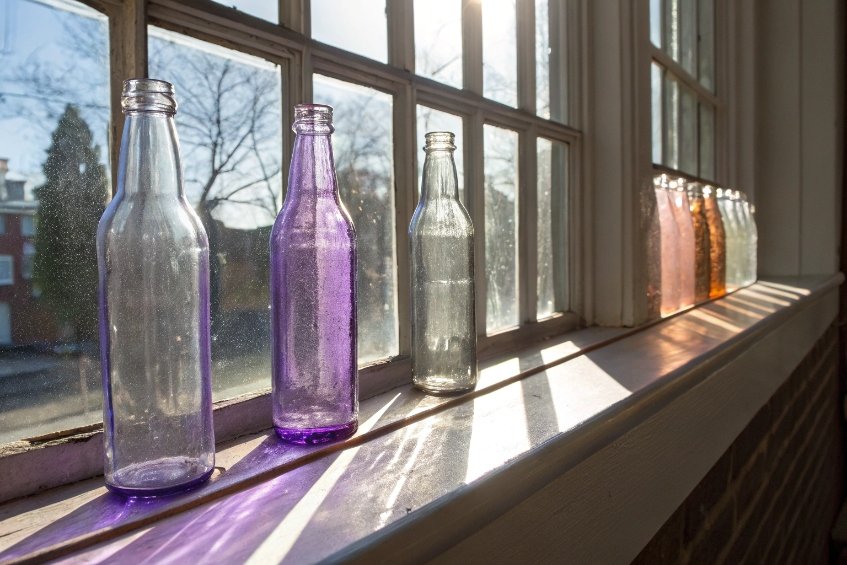
What light, moisture, and heat do to the glass surface
Clear glass is not always perfectly stable. In some compositions, manganese is used as a decolorizer. Over long UV exposure, manganese and other trace elements can change oxidation state. This can give flint glass a faint purple or brownish tint, known as solarization in manganese-decolorized bottles 3. The effect is slow, but outdoor storage or long exposure in sunlit displays can make it visible.
Moisture attack is often faster. When bottles sit in humid warehouses, on ocean journeys, or near caustic residues, alkali ions such as sodium and potassium leach from the surface. Water replaces them with hydrogen, and soluble salts form on top. This can create iridescent degradation layers 4, rainbow hues, or a cloudy, milky look. People often call this weathering or “blooming” on glass containers 5.
Strong alkaline solutions, such as returnable-bottle washers or aggressive detergents, push this further. They can micro-etch the glass surface. The result is a dull, matte, low-gloss look that does not wash off because the surface itself is changed. Acid attack can also etch, though its patterns are different.
High-heat cycles add another risk. Overheating during sterilization, flame work, or local re-heating can drive devitrification or phase separation near the surface. Small crystalline areas or phase-rich zones scatter light, so they look like opal patches or “stone-like” haze. Thermal gradients can also leave stress that later promotes weathering and fine cracks.
Hard water adds cosmetic damage on top. When bottles dry with hard water droplets on them, calcium and magnesium salts stay behind as spots and rings. These spots are not glass damage at first, but if they sit in a humid, slightly alkaline environment, they can trap moisture and speed up the start of true weathering underneath.
| Cause | Typical symptom on glass body | Mitigation |
|---|---|---|
| UV solarization | Slight purple or amber tint in flint | Control decolorizers, limit UV exposure |
| Alkali leaching / weathering | Iridescent film, haze, milky stains | Better storage climate, avoid caustic residue |
| Alkaline washer attack | Dull, etched, low-gloss surface | Control washer chemistry, time, temperature |
| Devitrification / phase split | Opal patches, crystalline-looking haze | Avoid overheating, control cooling rate |
| Hard-water drying | White spots, rings, “water marks” | Rinse with soft water, blow-off, fast drying |
Do coatings and inks yellow from over-bake, contamination, or solvent residue?
Decoration can be the first part the brand team sees, so any yellowing, browning, or haze in coatings and inks quickly becomes a complaint, even if the glass itself is fine.
Coatings and inks can yellow or darken when they are over-baked, contaminated, or not fully cured. Residual solvent, reaction with product ingredients, and heat history all change the color and transparency of organic systems on the bottle surface.
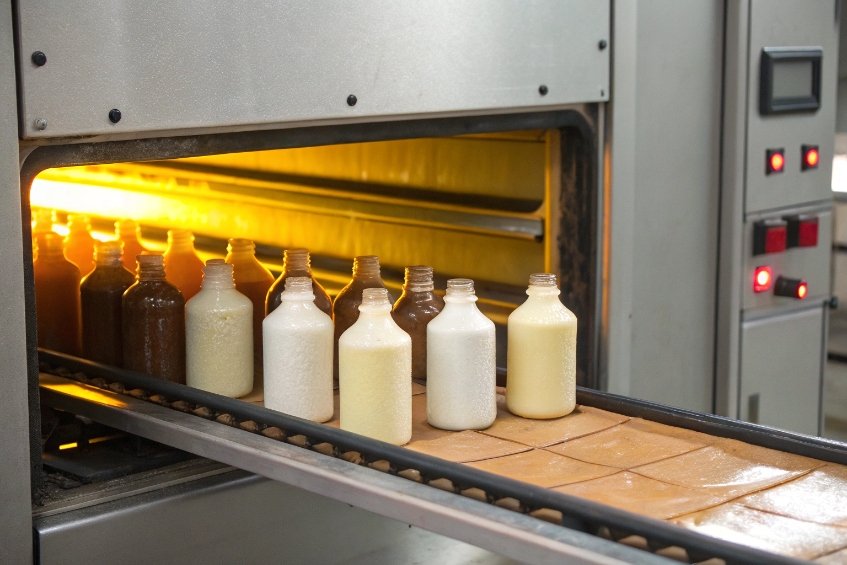
How decoration systems add their own color changes
Modern glass bottles often carry two main coating systems. The first is the hot-end metal oxide layer that improves scratch resistance and lubricity. The second is the cold-end organic or polymer coating that reduces scuffing in handling. On top of these, many bottles add screen-printed inks, decals, or labels with their own lacquers and adhesives. Many plants treat these as a paired system of hot-end and cold-end coatings 6, because one layer’s consistency affects the other’s performance.
The hot-end coating itself can cause visible color shift if it is uneven. Thick oxide in one area and thin in another can make gloss and tone look patchy. On flint or light colors, this patchiness shows as faint brownish or bluish bands. If sulfur compounds are used and not well controlled, dark amber or brown surface staining can appear, especially near the shoulder and heel.
Cold-end coatings are often organic. When they are over-baked or see multiple high-heat cycles (for example in lehr, then pasteurizer, then hot warehouse), they can yellow. Over-bake can also make the film brittle and prone to flaking. Under-bake, on the other hand, leaves high residual solvent. This can cause haze, smearing, and odor, and can react with the product or label adhesives.
Printed inks behave in a similar way. Ceramic inks that are fired into the surface are usually stable, but the medium that carries them can discolor if the firing schedule is not right. Organic inks and UV-curable systems are more sensitive. Over-cure can darken some pigments or clear coats. Under-cure leaves uncrosslinked material that can pick up dirt, absorb oils, or stain over time.
Contamination plays a silent role. Residual lubricants, release agents, cleaning chemicals, and label adhesives can all migrate into coatings or ink layers. Essential oils, solvents, and dyes from the product can also permeate into porous or under-cured layers. This leads to slow yellowing, edge staining near the heel, or “shadow” marks under labels.
| Layer / material | Main yellowing cause | Prevention focus |
|---|---|---|
| Hot-end oxide | Excess thickness, sulfur staining | Stable application, controlled sulfur and fuel |
| Cold-end polymer coating | Over-bake, multiple heat cycles | Tight cure window, avoid re-exposure to high heat |
| Screen-print / ink | Over-cure or under-cure of organic medium | Verified cure dose, correct firing schedule |
| Adhesives / residues | Migration into coating or glass | Clean surface, compatible label/adhesive choice |
| Product ingredients | Oil/solvent staining of coatings | Compatibility testing with real formulation |
Which storage and handling controls prevent color shift in glass bottles?
Even well-made glass and coatings will change if storage and handling conditions are bad. The environment around the pallet is part of the “process” as well.
The best way to keep color stable is to control humidity, chemicals, temperature, and contact conditions. Dry, clean storage, gentle handling, and protection from UV and harsh washers keep glass bodies clear and coatings bright for much longer.
Practical controls from cold end to customer
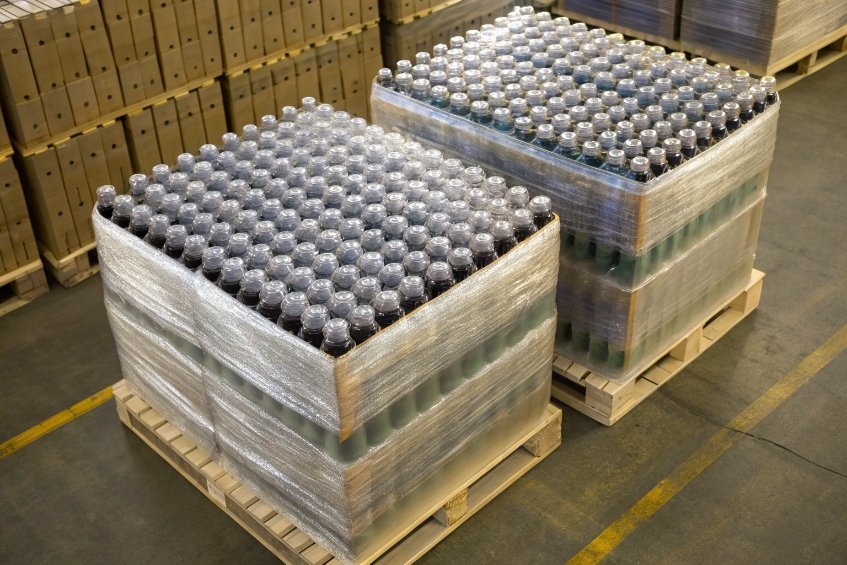
Right after the cold end, bottles are usually palletized and wrapped. If hot glass is wrapped too tight while still warm and wet, trapped moisture and condensation can promote weathering on the inner layers. A short cooling and drying step, correct shrink-wrap tension, and breathable top sheets reduce this risk.
Warehouse climate is critical. High humidity and strong temperature swings drive alkali leaching and condensation cycles. Whenever possible, long-term storage should stay in a dry, clean area with limited drafts of humid outside air. For export, pallets should be protected against sea air and salt spray, which accelerate surface corrosion.
Cleanliness matters as much as climate. Caustic spills, detergent residues, and dust that contains salts can sit on glass surfaces inside pallets. These residues pull moisture from the air and create small “wet spots” where weathering starts. Keeping floors and conveyors clean and avoiding chemical storage near glass storage reduce this risk.
Handling and conveying practices protect the surface gloss. Hard contact with metal guides, uncoated rails, or rough dividers scuffs the coating and glass. Over time, this creates gray “traffic lines” and dull bands. Using proper deadplate coatings, smooth guide materials, and correct conveyor speeds helps keep the surface clear and bright.
On returnable lines, the bottle washer is the key risk point. Caustic concentration, temperature, and time must match glass durability. Over-aggressive settings may remove labels well but slowly etch the glass body—especially when caustic bottle-washer chemistry promotes etching and scuffing 7. Good control, regular bath analysis, and proper rinsing with soft water protect both the glass and the coatings.
At the customer and consumer side, it helps to avoid long storage in direct sunlight or in very hot windows, especially for flint bottles with organic decoration. Education for downstream partners and simple packaging design choices, like cartons or sleeves, can cut UV exposure by a lot.
| Control area | Main risk addressed | Simple improvement step |
|---|---|---|
| Palletizing and wrap | Trapped moisture, condensation | Allow cooling, use breathable wrap or vent holes |
| Warehouse climate | Humidity, temperature cycling | Keep storage dry, limit direct outside airflow |
| Cleanliness | Chemical residues, salt, dust | Separate chemicals, improve housekeeping |
| Conveying / handling | Scuffing, traffic lines | Softer guides, better lubrication and line tuning |
| Returnable washers | Caustic etch, dulling of gloss | Optimize time/temp/NaOH, monitor bath and rinse |
| Downstream exposure | UV solarization, coating yellowing | Use cartons, sleeves, and shaded storage |
Conclusion
Glass body color stays stable only when chemistry, coatings, and environment all stay in control. When one of these drifts, discoloration is usually the first warning sign.
Footnotes
-
Explains how Fe²⁺/Fe³⁺ balance drives yellow-green vs blue-green color shifts in soda-lime glass. ↩ ↩
-
Shows how mixed-color container-glass cullet influences recycling and quality considerations. ↩ ↩
-
Describes why manganese-decolorized glass can turn purple after long UV exposure. ↩ ↩
-
Details the iridescence mechanism from thin weathering layers on glass surfaces. ↩ ↩
-
Practical explanation of blooming/weathering deposits and why moisture cycling triggers them. ↩ ↩
-
Overview of hot- and cold-end coatings used to protect glass and support label performance. ↩ ↩
-
Explains how caustic washer chemistry can etch glass and increase scuffing on returnable bottles. ↩ ↩






