
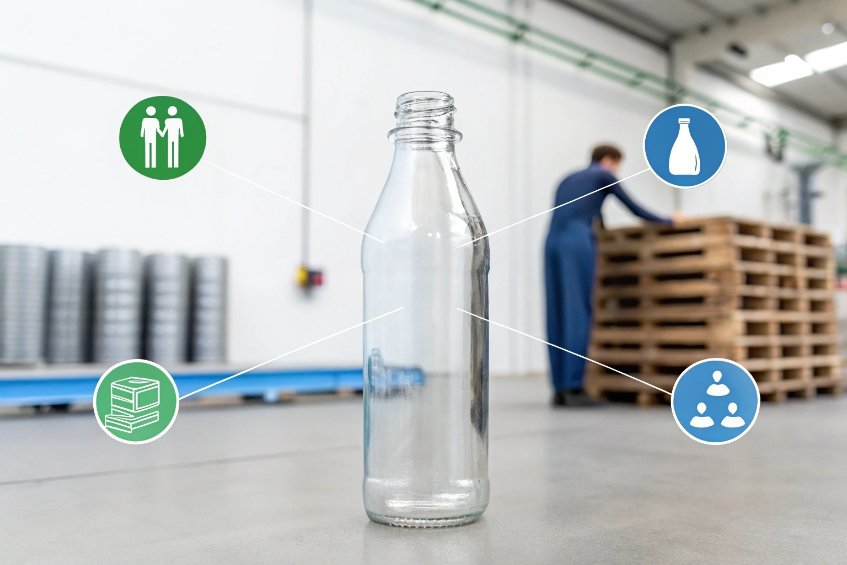
Coatings look like a “last step” in production, but they quietly decide whether a bottle survives the line, the warehouse, and the customer’s unboxing.
Glass bottle coatings protect strength, control slip, add barrier, and deliver color and special effects. A good system balances line efficiency, shelf appeal, and e-commerce durability in one coating stack.
From hot-end tin layers and cold-end slip coatings 1, from frost and metallic finishes to anti-fingerprint topcoats, every layer has a job. When we design coatings as a system instead of decoration, the plant gets fewer breaks, fewer scuffs, and fewer complaints, while the brand gets a more premium story on the shelf.
How do coatings improve scratch resistance, slip, and line efficiency?
Scratches start as tiny flaws, but they grow into breakage, line stoppages, and angry customers. A smart coating stack reduces how many flaws start in the first place.
Hot-end and cold-end coatings work together to lower friction, prevent scratches, and protect bottle strength. With controlled COF, lines can run faster, with fewer jams and less scuffing in transit.
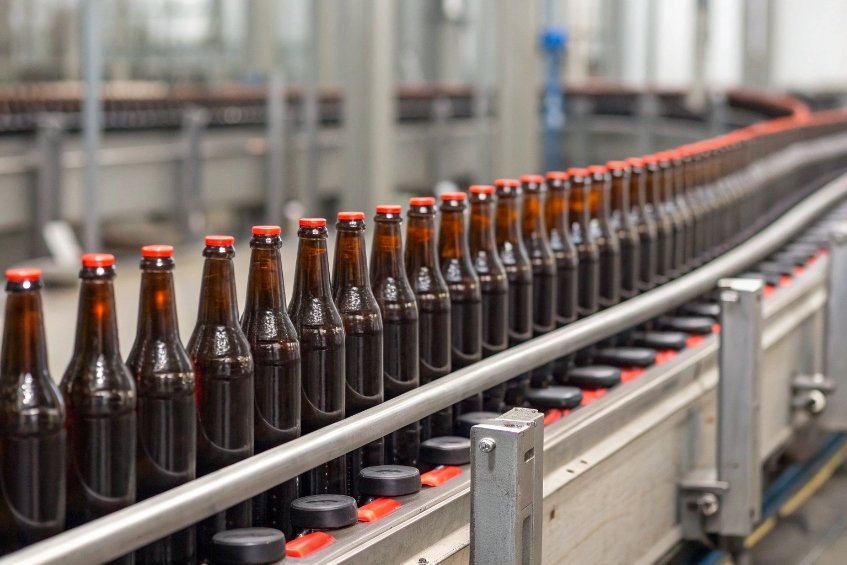
Building a “slip and strength” system
On bare glass, every contact point can create a crack starter: forming equipment, conveyors, guides, infeed stars, packers. Once surface flaws grow, internal pressure and impact resistance drop. Coatings do not make glass stronger by magic. They preserve the strength that the forming process already gave.
The typical protection system has two anchors:
-
Hot-end coatings (pyrolytic oxide)
A thin tin oxide (SnO₂) or similar layer is applied when the bottle is still hot—often via a chemical vapour deposition (CVD) process 2. This layer:- Forms a strong bond with the glass surface.
- Reduces direct glass-to-glass contact damage.
- Provides an excellent anchor for cold-end coatings.
-
Cold-end coatings (slip layers)
PE emulsions, waxes, stearates, or organosiloxane coatings sit on top of the hot-end layer. A common option is a polyethylene wax emulsion 3, which can:- Lower the coefficient of friction (COF) between bottles.
- Reduce scuffing in contact points, dividers, and cases.
- Allow higher line speeds without uncontrolled pile-ups.
To make this practical, we do not chase “maximum slip”. We define a coefficient of friction (COF) 4 window. Too slippery, and bottles slide uncontrollably in packers or on pallets. Too high, and they scuff and jam.
Key slip and scratch parameters
| Function | Typical coating layer | What we control | Target benefit |
|---|---|---|---|
| Preserve glass strength | Hot-end SnO₂ / FTO | Areal density, uniform coverage | Fewer strength-limiting surface flaws |
| Conveyor / contact slip | Cold-end PE / wax / siloxane | COF window (e.g. 0.08–0.14) | Stable high-speed conveying |
| Anti-scuff in packing | Same cold-end layer | Coverage on body/shoulder/neck | Less visual scuffing and haze |
Scratch resistance is not only about chemistry. It is also about film continuity and coverage uniformity. Thin or missing areas near shoulders or embossing quickly turn into scuff bands. That is why our process controls include COF mapping on multiple zones and visual checks after simulated line handling.
Do barrier and functional layers really extend shelf life?
Glass is already an excellent barrier. But some products push the limits: oxygen-sensitive juices, aroma-rich spirits, active cosmetics. In those cases, glass alone is sometimes not enough.
Barrier coatings like SiOx, AlOx, or hybrid sol–gel layers can lower oxygen ingress and aroma loss, while UV-blocking coats protect light-sensitive products. They act as a “second skin” around the glass.
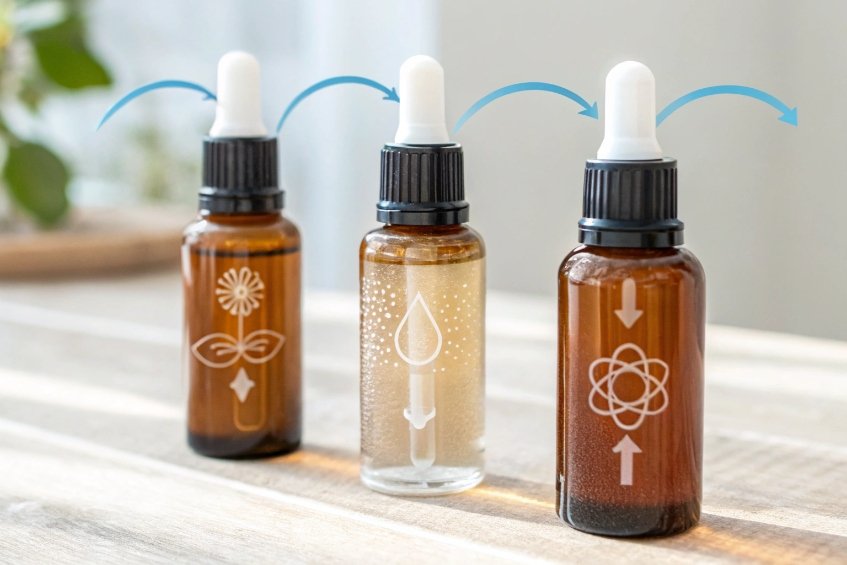
Using coatings as a “second barrier wall”
For many standard beverages and cosmetics, the glass wall plus closure is enough. But certain formulas are sensitive to:
- Oxygen (flavor change, color change, vitamin loss).
- Aroma loss (perfume, essential oils, high-end spirits).
- Light (UV-triggered degradation, light-strike in beer, rancidity in oils).
Here, coatings provide extra margin:
1. SiOx / AlOx and sol–gel barrier layers
Very thin inorganic or hybrid layers can:
- Reduce steady-state oxygen ingress.
- Slow aroma and small-molecule diffusion.
- Remain optically clear or only slightly tinted.
These layers are usually applied as:
- PVD or plasma-enhanced chemical vapor deposition (PECVD) 5 (vacuum/plasma processes).
- Sol–gel dips or sprays followed by a bake.
They must be thin enough not to flake and must bond strongly to the glass or hot-end coating below.
2. UV and light-control coatings
Certain resins, pigments, and oxides (for example TiO₂ coated glass 6 in the layer stack) provide:
- UV-blocking for clear or lightly tinted bottles.
- Light-strike protection for beer, wine, and oils.
- Control of haze and reflection, to keep a clean appearance.
Instead of using very dark glass for all products, we can selectively tune light protection by adjusting coating pigments and thickness.
Barrier and protection overview
| Need | Useful coating type | Typical application point |
|---|---|---|
| Extra oxygen / aroma barrier | SiOx / AlOx / sol–gel barrier | After anneal, before decoration |
| UV-blocking | TiO₂-rich or UV-absorber coatings | External, often colored or tinted |
| Caustic-wash durability | Inorganic-rich / hybrid hard-coats | Outer surface, returnable bottles |
In each case, the coating alone never carries shelf life. It adds margin to the existing glass and closure system. We confirm performance through real OTR (oxygen transmission rate) and product-stability tests, not only lab coupons.
How do coatings enable color effects, frosting, and metallic finishes?
The eye sees the coating long before it sees the brand logo. For many brands, the coating is the brand. Color, gloss, frost, and metallic finishes all come from how we design the outer layers.
Coatings give bottles color, frost, matte or high gloss, metallic reflections, gradients, and local effects. They turn neutral glass into a brand asset without changing the mold.
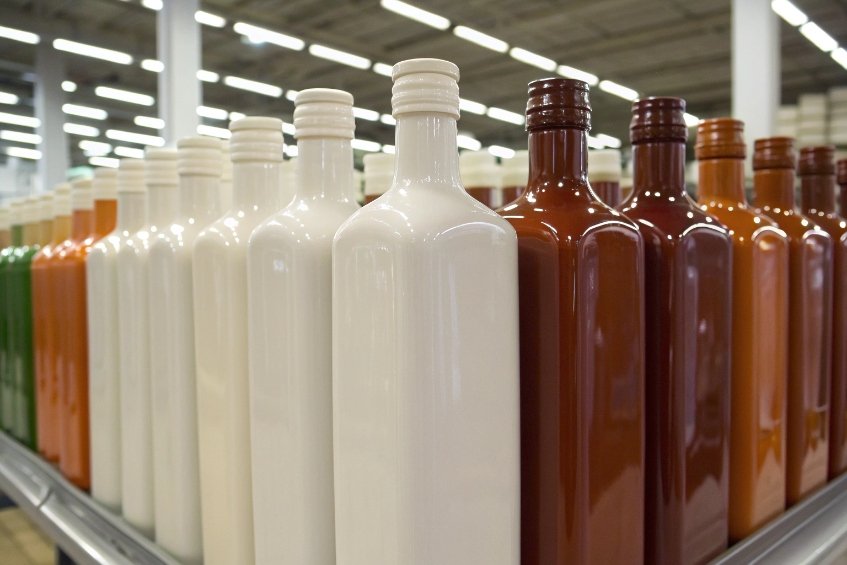
Turning clear glass into brand language
There are three big decorative “levers”:
1. Color and opacity
Using pigmented lacquers, enamels, or ceramic frits, coatings can:
- Create solid opaque colors (white, black, brand colors).
- Deliver translucent tints that still show the product.
- Support gradients, fades, and partial coverage (for example, a color band on the lower body).
Color layers must be balanced with:
- Film thickness (for hiding power and consistency).
- Gloss level (high gloss vs satin vs ultra-matte).
- Chemical resistance (caustic, alcohol, oils).
2. Frosting and tactile effects
Frosted looks can come from:
- True acid-etched surfaces.
- Sandblasted textures.
- Etch-look coatings or sol–gel micro-textures.
These provide:
- Softer, premium feel in hand.
- Diffused reflection, hiding minor scuffs.
- Extra grip in some designs.
We choose between real etch and “etch-look” coatings based on EHS, cost, and line flexibility. For many cosmetic and spirits projects, a sprayed etch-look coating over clear glass is enough.
3. Metallic and special-effect finishes
Metallic effects can be created using:
- Vacuum metallization 7 (aluminum or tinted metals).
- Metallic pigments in lacquers (flakes, pearls).
- Ceramic metallic inks fired in a lehr.
Typical looks:
- Mirror-like silver or gold.
- Soft pearlescent shine.
- Local metallic logos over a matte background.
These layers are almost always topped with a clear protective coat to improve scratch resistance and maintain appearance through the logistics chain.
Decorative function summary
| Visual effect | Typical technique | Key design checks |
|---|---|---|
| Solid color | Pigmented lacquer / enamel / frit | Color ΔE, gloss, adhesion |
| Frost / matte | Acid etch, blast, or etch-look coating | Uniformity, cleanability, label grip |
| Metallic / mirror | Metallization + clear coat | Adhesion, scratch resistance, opacity |
| Gradient / pattern | Masking, screens, digital, select spray | Edge sharpness, overlap, registration |
Because coatings sit on top of the glass, they let brands refresh designs or run limited editions without cutting new molds. That flexibility is critical for modern marketing and small-batch launches.
Which anti-scuff and anti-fingerprint options help e-commerce durability?
E-commerce changed how bottles are treated. Now they meet long parcel networks, more handling, and tighter packaging. Carton rub marks, label edge wear, and fingerprints are not just aesthetic issues; they influence perceived quality.
Anti-scuff and anti-fingerprint coatings protect appearance during long shipping cycles and repeated touch. They reduce carton rub, hide minor scratches, and keep bottles looking clean when the customer opens the box.
Designing for real-world abuse, not only lab shelves
Modern logistics create new risks:
- Bottles rubbing against dividers and each other in long transport.
- Label and coating damage from vibration.
- Fingerprints, smudges, and oil marks during picking and use.
To handle this, we combine several functions.
1. Anti-scuff coatings
These can be:
- Tough clear topcoats (UV or 2K) over decorative layers.
- Inorganic-rich or hybrid sol–gels that resist abrasion.
- Optimized cold-end slip systems that reduce carton rub marks.
They aim to:
- Reduce visible scuff lines along “rub zones” on the body and shoulder.
- Maintain gloss or matte level even after repeated contact.
- Keep printing and metallic finishes intact.
2. Anti-fingerprint and easy-clean surfaces
Hydrophobic and oleophobic topcoats, often based on organosilanes or fluorinated additives, can:
- Reduce visible fingerprint contrast on glossy or dark surfaces.
- Make smudges easy to wipe off without special cleaners.
- Enhance the “always new” look for high-end cosmetics and spirits.
These coatings must be thin and optically neutral to avoid changing color or gloss.
3. Shatter-containment and safety films
In some cases (e-commerce with high-value liquids, hospitality, or travel retail), shatter-containment coatings are used:
- A clear flexible layer that keeps fragments attached if the glass breaks.
- Reduces injury risk and product contamination.
- Helps brands manage risk in high-traffic or fragile segments.
While this is still a niche, it is growing where safety and brand reputation are critical.
E-commerce-focused functions
| Problem in e-commerce | Coating solution | Result at unboxing |
|---|---|---|
| Carton rub / shelf scuff | Anti-scuff topcoat + optimized slip | Clean panels, intact logos |
| Fingerprints and smudges | Hydrophobic / oleophobic topcoat | Fewer visible marks on dark bottles |
| Breakage mess and glass shards | Shatter-containment layer | Contained break, easier cleanup |
By designing coatings with the full e-commerce journey in mind—not only the first day on the shelf—we help brands keep their visual promise from the factory to the consumer’s hand.
Conclusion
Glass bottle coatings do far more than “look nice”. They protect strength, stabilize slip, add barrier and UV control, create color and special effects, and guard appearance all the way through e-commerce and daily use.
Footnotes
-
Practical overview of hot-end and cold-end surface treatments used on glass containers. ↩ ↩
-
Explains tin-oxide hot-end application using a controlled CVD process for uniform coverage. ↩ ↩
-
Notes polyethylene-wax cold-end coatings and how they reduce scratching and sticking on conveyors. ↩ ↩
-
Clear definition of coefficient of friction and why controlling it matters for sliding behavior. ↩ ↩
-
Describes SiOx “plasma glass” barrier coatings deposited by PECVD and their packaging barrier benefits. ↩ ↩
-
Research on TiO₂/ZnO thin films on glass and their UV-transmission reduction behavior. ↩ ↩
-
Quick explanation of vacuum metallization steps and why a protective topcoat is commonly applied. ↩ ↩






