
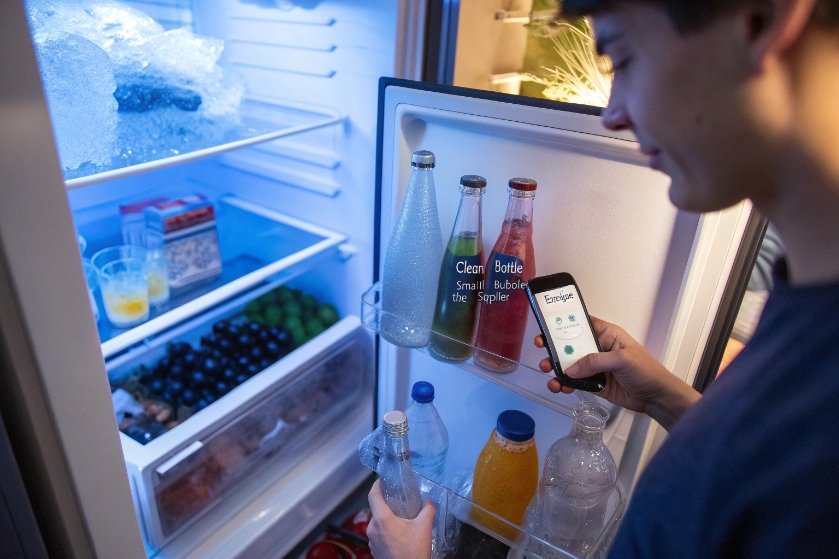
Sometimes customers send photos of a frozen bottle and ask, “It has bubbles in the glass—will it explode in my freezer?” The short answer is: possibly, but not because bubbles suddenly “go off.”
A glass bottle with bubbles is more likely to crack in the freezer because bubbles act as flaws that lower strength. The real driver of failure is liquid expansion and pressure from ice and CO₂, not the bubbles alone.
Bubbles in the glass wall reduce the safety margin. A strong, flawless bottle might survive a bad freeze that a “bubbly” bottle cannot. When the liquid expands into ice, pressure rises, and thermal shock kicks in, those bubbles make it easier for cracks to start. The good news is that with the right fill level, liquid, glass type, and freezer routine, the risk can be controlled.
Do bubbles in glass really make bottles explode in the freezer?
Many people imagine bubbles inside the glass suddenly popping like detonators. That is not what happens. The bottle breaks because of stress from the frozen liquid, and bubbles just make it easier for cracks to start.
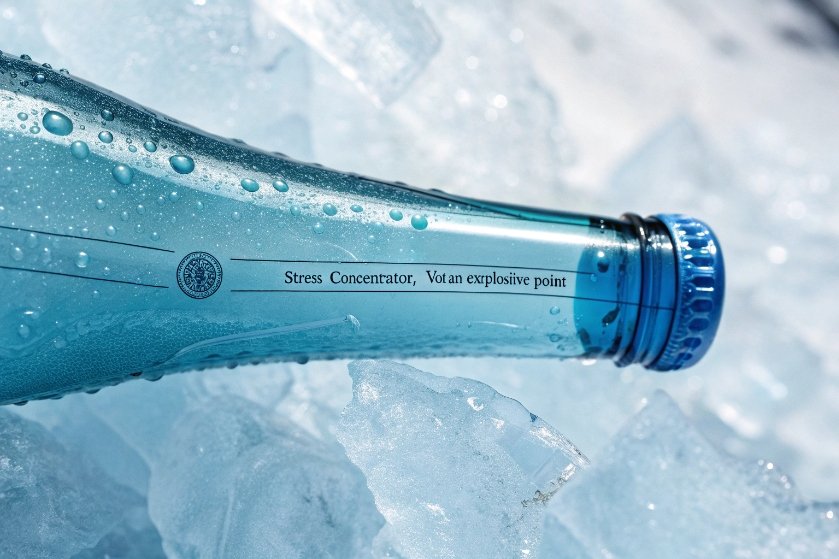
Internal bubbles do not explode by themselves. They act as stress concentrators, so under freeze and pressure stress the bottle can crack or shatter at lower loads than a clean bottle.
How bubbles and freezing work together
When a water-based liquid freezes, it expands about 9% as it freezes 1. In a rigid glass bottle, this expansion has nowhere to go. Pressure builds inside. At the same time, the outside of the bottle is colder than the inside, so thermal shock cracking from rapid temperature change 2 adds extra tensile stress to the glass wall.
1. Bubbles as crack starters, not bombs
A bubble is a small void in the glass wall. Around that void, stress lines bend and concentrate. This creates a local weak point. Under normal handling, the bottle may still be fine. Under strong freeze stress, these weak points “light up”—and fracture origins often become obvious when you use fractography for brittle-material failures 3.
So if two bottles see the same freezing conditions, the one with more or larger bubbles has a higher chance of cracking. The failure usually starts near those flaws. You see radial cracks or a broken shoulder or sidewall, not a “bubble explosion.”
2. Where bubble location matters most
Not all bubbles have the same effect. Location is key:
- Bubbles near the outer or inner surface are more dangerous. They sit right where tensile stress is highest during thermal shock.
- Bubbles in the shoulder or base radius are critical. These areas already carry strong mechanical loads.
- Bubbles in the finish or neck can weaken the sealing zone. Under pressure from ice or CO₂, this area may chip or crack.
Small, isolated seeds deep in the body wall are much less critical. They still lower strength slightly, but the effect is modest compared with large surface-adjacent bubbles or blisters.
3. How often do “explosions” really happen?
Most failures are cracks and local fractures, not movie-style explosions. The bottle might split and leak slowly in the freezer. Sometimes, if the bottle is very full, very tight, and already flawed, it can shatter more violently and leave glass and frozen drink everywhere. Bubbles make this scenario more likely but are not the primary cause.
You can think of it this way:
| Factor | What it does |
|---|---|
| Liquid expansion | Creates high internal pressure |
| Thermal shock | Adds tensile stress in the glass wall |
| Bubbles / flaws | Lower the stress needed to start a crack |
If the combined stress stays below the weakened strength, nothing happens. Once it passes that limit, the bottle fails. Bubbles simply move that limit down.
How do fill level, carbonation, and liquid type change the risk?
Two identical bottles can see very different outcomes in the freezer, depending on what is inside and how full they are. The content and headspace are often more important than the glass recipe.
Risk rises sharply when the bottle is very full, tightly sealed, and filled with water-rich or carbonated liquids. More headspace, lower carbonation, and higher sugar or alcohol content reduce stress but do not remove it.
Why what you put in the bottle matters more than most people think
Inside the bottle, freezing water and dissolved gas decide how much pressure builds. The glass only reacts to that pressure.
1. Fill level and headspace
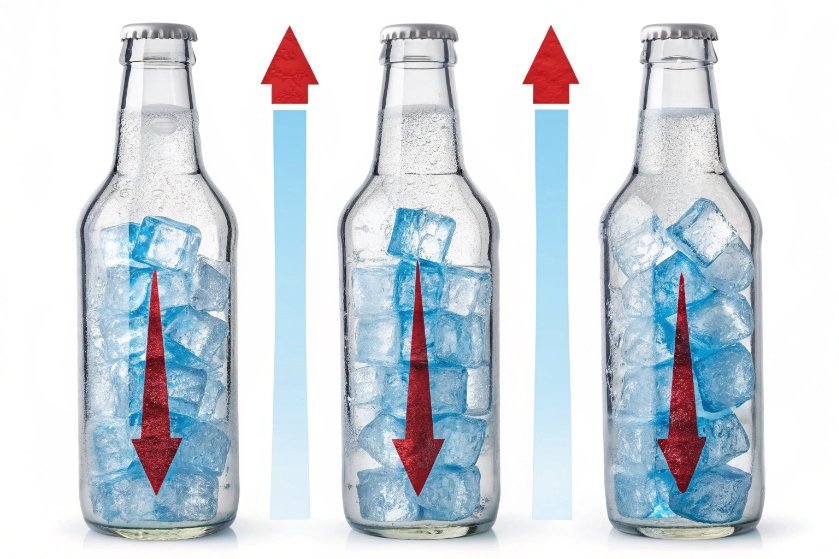
Water expands around 9% when it turns to ice. If the bottle is filled almost to the brim and sealed, there is not enough space for this extra volume. Pressure climbs quickly. The weakest point in the glass or finish will give way.
If there is generous headspace (for example, 10–15% of the bottle volume), the expanding ice can push into the air space. Air compresses; glass does not. That compression absorbs some of the expansion without pushing stress past the breaking point.
2. Carbonation level
Carbonated drinks are the worst case in glass freezers. When ice forms, CO₂ is pushed out of the ice phase into the remaining liquid and the headspace. This raises gas pressure on top of the expansion stress (a very practical, everyday example of Henry’s law gas–liquid equilibrium 4).
So for a carbonated product you get:
- Volume expansion from ice
- Gas pressure rise from CO₂ being squeezed out
This combination can overload even a strong, bubble-free bottle. With bubbles and micro-cracks present, the risk is much higher. This is why the safest rule is simple: do not freeze carbonated drinks in glass.
3. Liquid composition: sugar, alcohol, and solids
Not every liquid freezes like pure water. Sugar lowers the freezing point and changes how ice forms. Alcohol does this even more. A high-alcohol spirit may not freeze solid in a normal freezer, so the expansion stress stays lower.
Viscous liquids, pulps, and suspensions can freeze unevenly. Local pockets may expand differently, creating complex stress patterns. This can still damage bottles, especially if the shoulder or base geometry is sharp.
We can summarize freeze risk like this:
| Liquid type | Typical freezer risk in glass (with tight cap, high fill) |
|---|---|
| Still water | High |
| Juice / tea / coffee | High |
| Carbonated soda / beer | Very high (avoid) |
| Syrups, high-sugar drinks | Medium to high (depends on recipe) |
| Spirits (40%+ ABV) | Lower, but glass can still crack if abused |
Bubbles in the glass lower the safe line for every row in this table.
Which glass compositions and thicknesses are safer for freezing?
Some customers ask for a “freezer-safe glass bottle.” In practice, no standard bottle is fully safe under all conditions, but some designs and glass types cope better with cold and thermal shock.
Borosilicate glass handles thermal shock better than standard soda-lime, and heavier, more uniform walls give extra margin. However, any glass will fail if you ignore headspace and fill it with freezing, expanding liquids.
What glass type and design can and cannot do for you
Glass composition and design can raise or lower the stress level that causes failure, but they cannot fight basic physics of ice expansion.
1. Soda-lime vs borosilicate
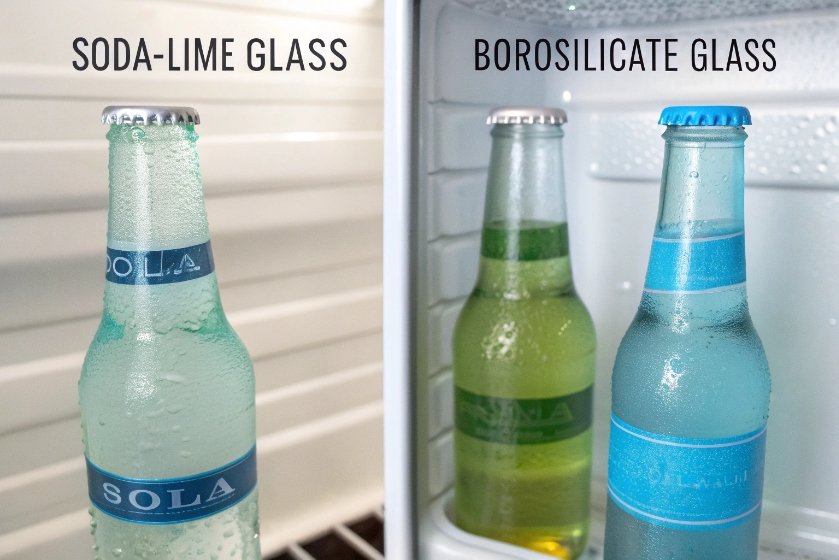
- Soda-lime is the normal glass for food and beverage bottles. It has higher thermal expansion and lower thermal-shock resistance. It is optimized for strength, cost, and recyclability.
- Borosilicate has lower thermal expansion and better resistance to sudden hot ↔ cold changes; it’s widely noted that borosilicate’s expansion can be far lower than typical soda–lime–silica glass in discussions of glass types and thermal expansion 5.
For freezing, borosilicate gives extra safety margin against thermal shock when bottles move from room temperature to the freezer or vice versa. It does not solve the pressure from expanding ice. A full borosilicate bottle can still crack if the liquid freezes solid.
2. Wall thickness and geometry
Thicker and more uniform walls can spread stress more evenly. Heavy-based spirit bottles, for example, often survive more abuse than very thin lightweight containers. Smooth, generous radii at the shoulder and base handle stress better than sharp corners.
At the same time, extreme thickness can create its own thermal gradients. If the outer shell gets very cold while the inner side is still warm, the stress between these layers rises. So design must balance thickness with good shape and controlled use.
3. Bubbles + thin walls = low reserve
In lightweight bottles, any flaw matters more. The wall is thinner, so there is less “solid” material around a bubble to carry stress. When these bottles are used for freezing, bubbles and seeds cut deeper into the safety margin than they would in a heavy container.
A simple view of relative safety:
| Glass / design type | Relative tolerance to freezing abuse* |
|---|---|
| Thin soda-lime, many bubbles | Very low |
| Thin soda-lime, clean glass | Low |
| Standard soda-lime, clean glass | Medium (with good headspace and slow freeze) |
| Heavy soda-lime, smooth shape | Higher, but not foolproof |
| Borosilicate bottle, good design | Higher thermal margin, still needs headspace |
*This assumes water-based liquids and non-carbonated products.
What precautions should I take for cold storage and defrosting?
Many people do not have the option to change bottle design. What they can control is how they fill, freeze, and thaw. This is where most of the practical safety lies.
To reduce risk, leave generous headspace, avoid carbonated drinks in glass, cool and freeze gradually, loosen tight caps, choose suitable containers, and thaw bottles slowly without hot water shocks.
A simple safety routine for glass in the cold
When freezing or very cold storage is unavoidable, habits matter more than theory.
1. Before freezing
- Inspect the bottle for chips, cracks, or big bubbles in the shoulder, base, or finish. If you see serious flaws, do not use that bottle for freezing.
- Leave headspace. Aim for at least 10–15% of the volume for water-based liquids. More is better.
- Do not fully tighten the cap. Close it lightly so it holds dust out but can still lift if pressure rises. For long storage, you can retighten after the liquid is fully frozen, if needed.
- Avoid carbonated products. Use a different container or skip the freezer.
If you need a conservative, food-safety-style reference for container choice and extra headspace, see containers and headspace guidance for freezing in glass 6.
2. Cooling and freezing
- Cool in stages. Let the filled bottle sit at room temperature, then in the refrigerator, then move it to the freezer. Avoid going straight from hot or warm to deep cold.
- Place the bottle upright, not on its side. This helps ice expand upwards into the headspace instead of sideways into the walls.
- Keep the bottle away from the coldest spot or fan outlet, which can cause very sharp temperature gradients.
3. Storage in very cold conditions
For long-term cold storage just above or slightly below 0°C, risk is lower because the liquid may not freeze fully. Even so, bottles with bubbles and other flaws should not be used at maximum possible internal pressure—basic pressure-vessel hoop stress 7 logic still applies when you turn a sealed bottle into a stressed container.
4. Defrosting and use
- Do not thaw with hot water. A frozen bottle under hot tap water is a classic thermal-shock failure.
- Thaw slowly in the refrigerator or at room temperature on a tray. Let the ice melt quietly.
- Do not try to speed up defrosting in the microwave or oven unless the container is clearly rated for that use by the maker. Standard beverage bottles are not.
- Expect some damage. If a bottle has been frozen hard, treat it as suspect. Even if it looks fine, small cracks may exist. Open it gently, keep it away from faces and eyes, and consider discarding it for future re-use.
5. If freezing is a regular need
If freezing liquids is part of normal use, the best solution is simple:
- Use plastic freezer containers, or
- Use purpose-built freezer-safe glass clearly rated by the manufacturer.
Standard soda or wine bottles, especially those with visible bubbles or surface defects, are tools for filling and distribution, not for cycling through hard freezing and thawing.
Conclusion
A glass bottle with bubbles will not explode just because of the bubbles, but those flaws lower its strength. With expanding ice, CO₂, and thermal shock added, good freezing habits are the only real protection.
Footnotes
-
Explains ice’s lower density—basis for ~9% expansion that cracks rigid containers. ↩ ↩
-
Shows how rapid temperature gradients create tensile stress and cracking in glass. ↩ ↩
-
Helps identify fracture origins and how small flaws trigger brittle failure. ↩ ↩
-
Explains why dissolved CO₂ pressure behavior changes as conditions shift during freezing. ↩ ↩
-
Summarizes borosilicate vs soda–lime expansion behavior and why it matters for thermal shock. ↩ ↩
-
Practical guidance on glass containers, headspace, and why jars can break at the neck. ↩ ↩
-
Explains hoop stress in thin-walled containers—useful mental model for sealed-bottle pressure risk. ↩ ↩






