
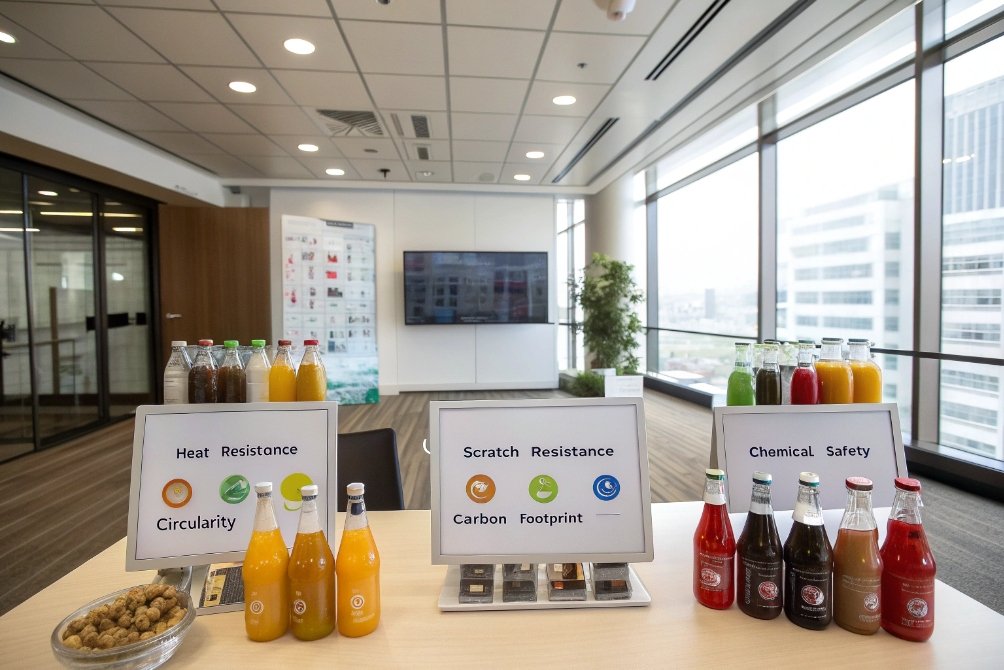
Brands that fill into plastic often worry about heat, flavor, and image, but switching everything to glass can feel risky and expensive.
Glass bottles bring higher heat and scratch resistance, near-zero flavor leaching, and true closed-loop recycling, while PET wins on weight and transport. The right choice depends on product, process, and how you treat carbon and reuse.
I like to look at four simple questions: heat and scratch resistance, chemical safety, circularity, and lifecycle carbon. When we walk through each one, the trade-offs between glass and plastic become very clear.
Is glass more heat- and scratch-resistant than PET?
Many teams only notice packaging limits when a hot-fill line warps their PET bottles or when scuffed packs look tired on the shelf.
Glass bottles handle high heat and cleaning far better than PET, and they resist scratching more, although scuffs are more visible. PET wins on impact resistance but has clear limits in hot-fill, pasteurization, and repeated washing.
Heat resistance: sterilization, hot-fill, and reuse
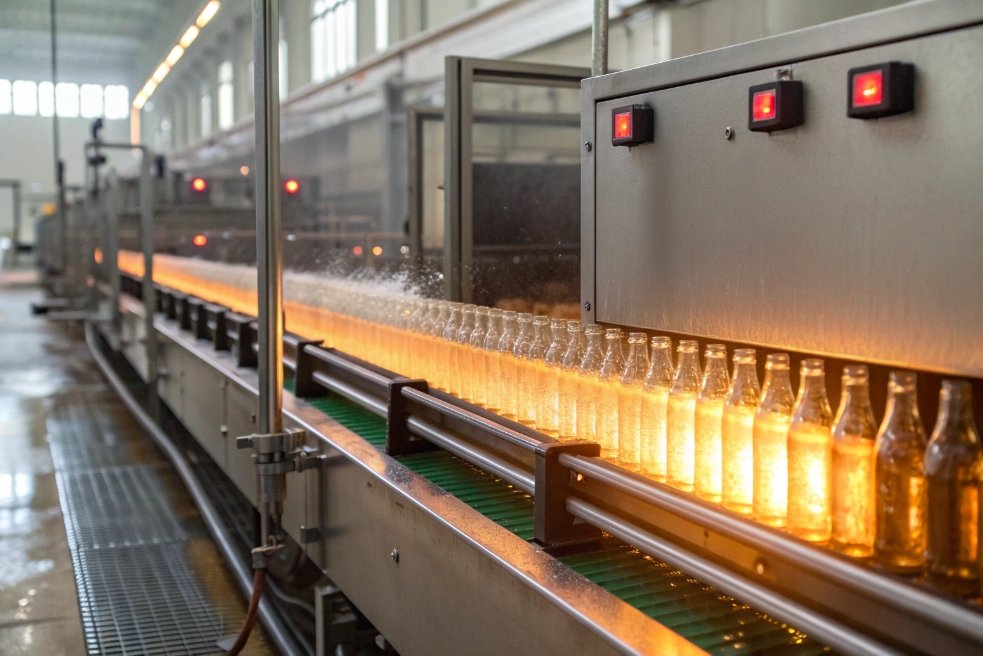
Glass is a rigid, inorganic material. It keeps shape in ovens, tunnel pasteurizers, and high-temperature washers. You can run glass through hot-fill, CIP-style washing, and even autoclave-type conditions if the design and annealing are correct. The bottle does not soften and it does not absorb smells.
Standard PET 1 softens much earlier. Many regular PET bottles start to deform around hot tap water temperatures. Heat-set PET can handle higher hot-fill temperatures, but it still sits well below the limits of glass. Repeated hot cycles will slowly tire PET and can make the walls cloudy or wavy. That is why most refill and high-heat systems choose glass.
Scratch resistance and surface durability
Glass is harder than PET. Conveyor contact, crate movement, and shelf handling create scuffs on both materials, but glass usually keeps its shape and clarity longer. Surface coatings on glass improve slip and reduce scratching, especially in refillable pools.
PET is softer, so it picks up fine scratches more easily. These marks can dull the look and weaken the wall over time. On the other hand, PET bounces, while glass chips or shatters when the impact is high enough. So the real picture is simple:
| Property | Glass bottles | PET bottles |
|---|---|---|
| Heat resistance | Very high | Limited, needs special grades |
| Scratch resistance | High hardness, scuffs visible | Softer, scuffs easier to form |
| Impact resistance | Brittle, can shatter | Flexible, more impact tolerant |
| Reuse at high temp | Strong candidate | Narrow window, more constraints |
When a process needs heat, tough washing, and long life, glass has a clear edge.
How do glass and plastic compare on chemical leaching and product safety?
Many consumers now read labels and worry about what might migrate from the package into their drink or sauce.
Glass is chemically inert and non-porous, so it does not leach additives or absorb aromas. PET is well controlled and usually safe when used within its design limits, but it remains an organic polymer with potential for small migrations and odor memory.
Chemical interaction and leaching
Glass acts like a stable shell. Under normal food and beverage conditions it does not release harmful substances. There are no plasticizers or monomers in the glass matrix. For acidic juices, alcohol, oils, or strong aromas, this is a big advantage. Many regulators 2 treat glass as the default safe material for direct food contact.
PET and other plastics must pass strict migration tests, and reputable suppliers design them to stay inside regulatory limits. But they still have organic chains and additives that can move in tiny amounts. Strong alcohols, high-fat products, long storage times, and high temperatures can all push migration up. This is why many high-proof spirits 3 and aggressive essential oils stay in glass.
Odor, flavor memory, and barrier
Glass does not absorb or release odors. After washing, a glass bottle does not remember what it held before. That makes it ideal for refill systems and for products with fine aroma profiles. Non-porous walls also mean oxygen and moisture do not move through the glass itself.
PET has decent barrier properties for many drinks, but it is not perfect. Oxygen can move through the wall over long storage. Aroma molecules can also be absorbed and later released. Anyone who has smelled a reused PET bottle understands this effect. For high-value or sensitive products, this is a risk.
A simple comparison:
| Aspect | Glass bottles | PET bottles |
|---|---|---|
| Chemical inertness | Very high | High but resin- and use-dependent |
| Additives in matrix | None for structure | Present (stabilizers, modifiers, etc.) |
| Odor and flavor memory | None | Can absorb and release odors |
| Oxygen / moisture wall | Near-zero permeability | Some permeability over time |
So if a brand needs the cleanest possible contact surface and long, stable shelf life, glass is the safer choice.
Which material wins on circularity and recycled content?
Sustainability teams now talk about “circularity” more than “recycling.” The question is not only if a pack can be recycled, but if it actually comes back as the same thing again.
Glass can be recycled endlessly into new glass bottles with almost no loss of quality, and it works well in refill systems. PET can also be recycled, but it often ends up down-cycled or mixed, and quality depends heavily on local systems.
Closed-loop recycling potential
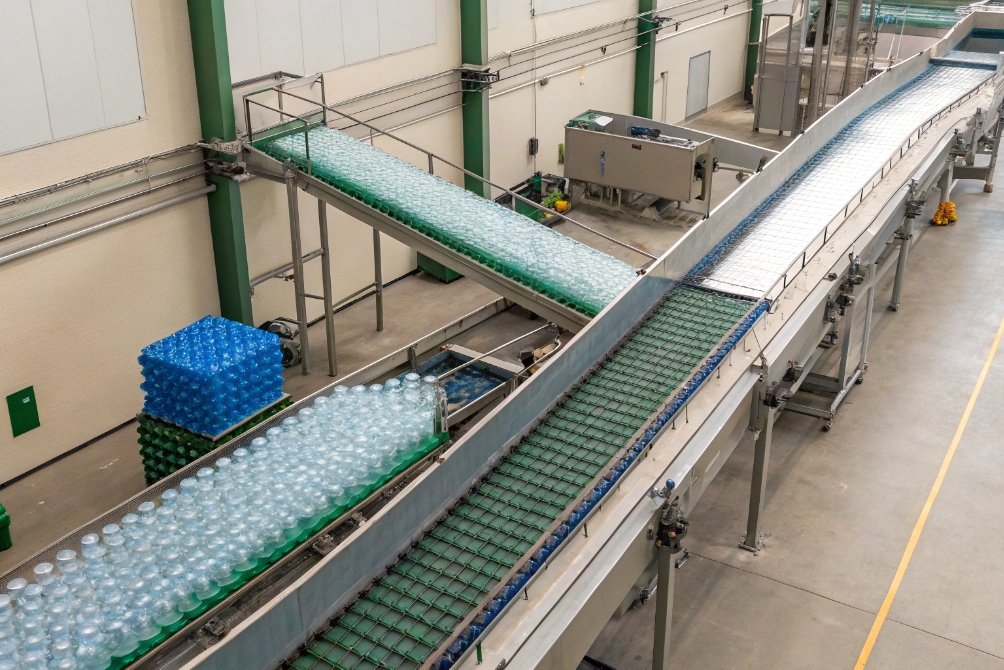
Crushed glass (cullet) melts back into new glass very easily. A brown bottle can become a brown bottle again. There is no real limit on the number of loops, as long as sorting and color control are good. High cullet rates cut furnace energy use and raw material demand. This is real closed-loop recycling.
PET recycling is more complex. Clear bottle-to-bottle recycling exists and is improving, but it needs clean, sorted streams and careful control of contaminants. Many PET bottles end up as fibers, strapping, or mixed plastics instead of new bottles. This is not full circularity. It is a one-way path toward lower-value products.
Refill and reuse systems
Glass works very well in deposit and refill systems. A sturdy bottle can survive many trips through filling, washing, and distribution. Studies show that refillable glass can cut carbon emissions sharply compared with single-use PET or single-use glass, especially when the reuse loop is local.
PET refill systems exist, but high heat washing, scratch build-up, and perception issues limit them. Scratches in PET can harbor dirt and reduce strength. Many retailers and regulators prefer glass where long-term multi-use is involved.
A short view:
| Circularity factor | Glass bottles | PET bottles |
|---|---|---|
| Recyclability | Infinite, closed-loop possible | Good, but quality loss and down-cycling |
| Recycled content | High levels technically possible | Growing, but limited by food-contact rules |
| Reuse suitability | Very good, especially locally | Possible but more constrained |
| System dependence | Needs color-sorted cullet | Needs very pure sorting and decontamination |
So on paper, glass is the stronger circular material, especially when brands invest in high-return refill loops and high cullet content.
What are the real differences in lifecycle carbon?
At this point many people say, “Glass is heavier, so it must always be worse for carbon.” The reality is more nuanced.
Single-use glass usually has a higher carbon footprint per unit than single-use PET because furnaces and transport use more energy. But lightweight designs, high recycled content, and especially refill systems can bring glass close to, or better than, PET on a lifecycle basis.
Where glass pays a carbon penalty
Melting glass takes high temperatures. Furnaces run hot and often use fossil fuels or electricity with mixed sources. A heavy one-way bottle also means more mass on every truck, ship, or pallet. So if a brand uses thick, premium bottles once and ships them far, the CO₂ number per liter is high.
PET melts at much lower temperatures and weighs less. For a one-way, long-distance pack, PET often shows lower carbon per bottle at the factory gate and during transport. If the bottle is collected and recycled into new PET, the benefit grows.
How design, reuse, and recycling change the answer
The story changes when the design changes. If a glass bottle is light-weighted, made with a high cullet percentage, and used in a regional refill system, the carbon per trip drops a lot. Over many refill cycles, the original furnace impact spreads out. Some studies show that refillable glass can cut emissions by around three quarters compared with single-use PET and even more compared with single-use glass, when the loop is tight and return rates are high.
Good logistics also matter. Shorter routes, backhauls, and efficient washing reduce the gap between glass and PET. On the plastic side, if recycling rates are low and bottles often end in landfill or incineration, the long-term environmental picture looks worse than the pure CO₂ number at filling.
Here is a simple way to see it:
| Scenario | Likely lower carbon today* |
|---|---|
| Heavy one-way, long-distance | PET |
| Light-weight one-way, local | PET often lower, gap smaller |
| Refillable glass, local loop | Often glass, if reuse is high |
| Poor recycling infrastructure | Depends, but PET waste impact high |
*Actual results always depend on local energy mix and systems.
So glass does not always win on carbon. But with smart design, short loops, and either high reuse or strong recycling, glass can compete well while still giving clear advantages in safety and product quality.
Conclusion
Glass bottles beat plastic on heat resistance, scratch and flavor stability, and true circularity. PET still wins on weight and some carbon scenarios, but smart, light, and refillable glass can close that gap while keeping product quality and brand image at a higher level.






